
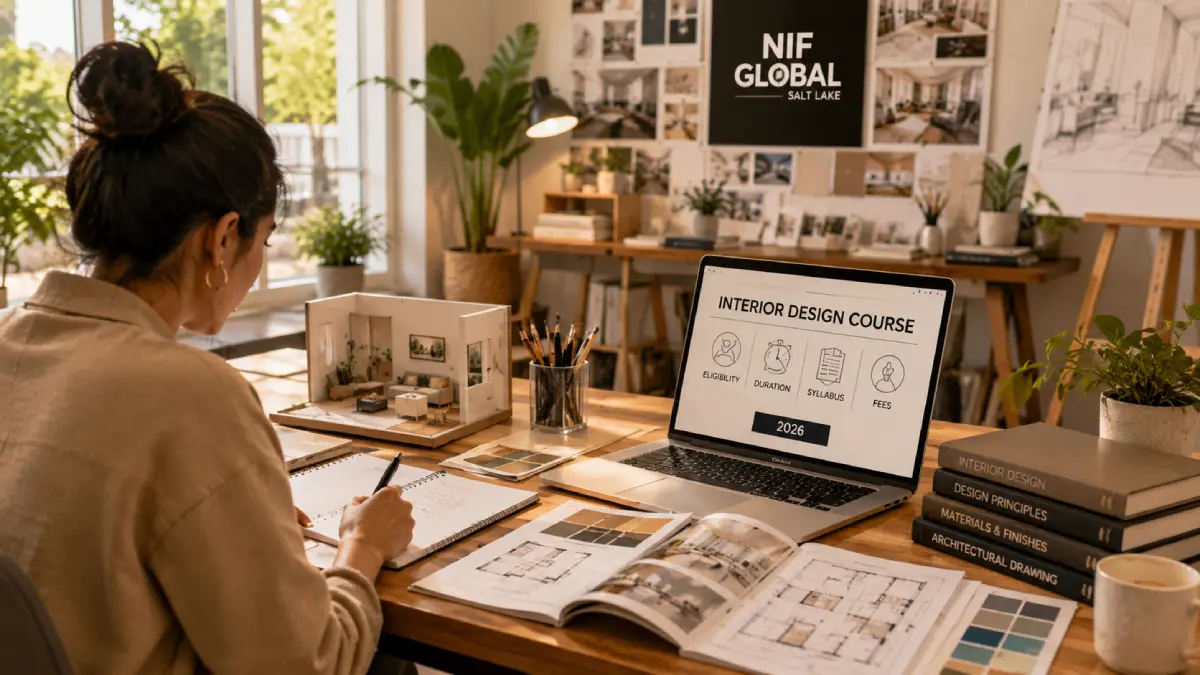
Choosing an interior design course in Kolkata means planning your next few years and thinking about the designer you want to become. This guide answers common questions about eligibility, duration, syllabus and fees for our Salt Lake campus’s 2026–27 session. You’ll also find things to check when comparing institutes, so you and your parents can make a more informed choice.
The best interior design courses in Kolkata combine three things: a recognised qualification, real studio and site exposure, and placement support that continues after you graduate. Plenty of institutes in West Bengal teach design software. Fewer teach you how a space is actually built, priced and handed over to a client.
At NIF Global Saltlake Kolkata, the interior design course Kolkata students choose from comes in four formats. Each one suits a different stage of life and career goal.
| Programme | Duration | Best for | Eligibility |
|---|---|---|---|
| B. Des Interior Design | 4 years | Students who want a full degree with depth in design theory and practice | 10+2, minimum 50%, any stream |
| B. Voc Interior Design | 3 years | Students who want a skills-led degree and an earlier start to working life | 10+2, minimum 50%, any stream |
| M.Voc Interior Design | 2 years | Graduates who want a postgraduate qualification and specialisation | Graduation in a relevant field |
| 2-year advanced programme | 2 years | Career changers and students who want job-ready skills fast | 10+2 pass or appearing |
You can see the full programme details on our interior design course page.
The basic rule is simple. You need eligibility 10+2 from a recognised board, and your stream does not matter. Science, commerce and arts students all join our programmes. Plenty of strong designers come from commerce and humanities, because the work relies on observation, communication and problem-solving as much as maths.
A few practical points:
If you have a specific question about documents or admission timelines, our Admission FAQ covers the common ones.
Duration depends on the qualification you want, not on how “serious” you are about design. Here is how to think about it.
The option to take up B.Des for interior design provides you with more freedom. The initial years will teach you basics like drawing, colour, form and the history of design. The latter years will have you working on elaborate residential and commercial projects.
The B.Voc. interior design degree is vocational by design. That means more hands-on studio hours and practical training from the first year. It suits students who know they want to work as designers and want a recognised degree that gets them there a year earlier.
The M.Voc course in Interior Designing is designed for students who wish to hone their abilities or transition into interior designing from other professions. The 2-year advanced programme is an intensive course for 10+2 students who wish to follow a faster route. There is a 1-year advanced programme as well for students who require core skills immediately.
A good interior design syllabus moves you from “I like nice rooms” to “I can design, document and deliver a space.” Here is what you will typically study across our programmes.
| Area | What you learn |
|---|---|
| Design foundations | Sketching, colour theory, elements and principles of design, history of interiors |
| Space planning | Room layouts, circulation, ergonomics, zoning for homes, offices and retail |
| Furniture and lighting design | Furniture proportions, joinery basics, natural and artificial lighting, mood creation |
| Material selection | Wood, laminates, stone, tiles, fabrics, paints and finishes, cost and durability |
| Technical drawing | Plans, elevations, sections, working drawings and detailing |
| 3D visualisation | Digital modelling and rendering to present ideas to clients |
| Professional practice | Estimation, client briefs, vendor coordination, project management |
Software training. Students learn the industry-standard tools used for drafting, modelling and rendering. Our Autodesk-certified training connects classroom drafting to what design firms expect on day one. Ask our counsellors for the current software list for your programme.
Theory on its own will not turn someone into a designer. This is why our courses involve studio assignments that revolve around actual briefs, such as designing a two-bedroom apartment, a café, or a retail space. Site visits happen regularly, allowing you to view firsthand how construction and finishing works. This is when the majority of students realise why precision matters in a drawing.
All of this feeds into your portfolio, which is the single most important thing an employer or client will look at. A degree gets you the interview. A strong portfolio gets you the job.
For a closer look at the programme structure, download the interior design brochure.
Fees for an interior design course in Kolkata vary widely between institutes and between programmes at the same institute. Rather than comparing one headline number, compare what the fee actually includes.
Things that change the fee:
Our tip: when you collect fee details from any institute, ask for the total cost across the whole programme, and ask what is not covered. That gives you a fair comparison. Our counsellors at the Salt Lake campus share the current 2026 fee structure and instalment options on request.
Neither one is “better” in general. The right choice depends on how you like to learn and when you want to start working.
| Factor | B.Des Interior Design | B. Voc Interior Design |
|---|---|---|
| Duration | 4 years | 3 years |
| Learning style | Broad design education plus practice | Skills-first, heavy on practical training |
| Ideal for | Students aiming for design leadership, further study or specialised roles | Students who want to enter the industry sooner |
| Outcome | Bachelor’s degree with a deep portfolio | Bachelor’s degree with strong job-ready skills |
If you are still unsure, book a campus visit. Seeing student work in the studio usually settles the question. You can explore the studios first through our campus tour.
Demand for interior designers in Kolkata and across West Bengal keeps growing. New housing projects, cafés, co-working spaces and retail brands all need trained designers. Common career paths include:
Regarding the interior designer salary, in Kolkata, the average interior designer salary is estimated to be somewhere between ₹5 lakh and ₹6 lakh annually, based on experience, skills, and the company that offers you the position. Beginners tend to get paid less but will see fast growth through good projects. Some of our students have landed jobs at Asian Paints, Godrej Interio, Hettich, Homelane, and Pidilite.
For more information about these positions, we recommend you take a look at our interior design career options guide or our blog article about the career potential of interior design.
Before you pay an admission fee anywhere, check these five things:
With over 30 years in design education, NIF Global Saltlake Kolkata has been named a Platinum Centre in India. You can read more about NIF Global Saltlake Kolkata and our teaching approach.
Students from any stream can apply after 10+2 or while appearing; degrees require 50% in 10+2, and M.Voc requires graduation.
Course duration depends on the programme: B.Design takes 4 years, B.Voc takes 3, and M.Voc takes 2. Advanced programmes offer shorter 1-year or 2-year options.
Students learn space planning, furniture, lighting, materials, technical drawing, 3D visualisation, professional practice, and industry-standard drafting, modelling and rendering software.
Interior design course fees vary by programme and inclusions. Contact NIF Global Saltlake Kolkata for its current 2026 fee structure.
B.Des offers a broader, four-year design education. B.Voc provides practical, three-year training for earlier employment. Both lead to recognised bachelor’s degrees.
Graduates can pursue interior, furniture, lighting, exhibition or set design, consultancy or freelancing. Kolkata interior designers average ₹5–6 lakh annually, depending on experience.
No. NIF Global Saltlake Kolkata offers only on-campus interior design courses, emphasising studio work, site visits, and hands-on material training.
Interior design plans functional spaces, while interior decoration enhances aesthetics through colours, furnishings and accessories. Design courses typically cover both.