
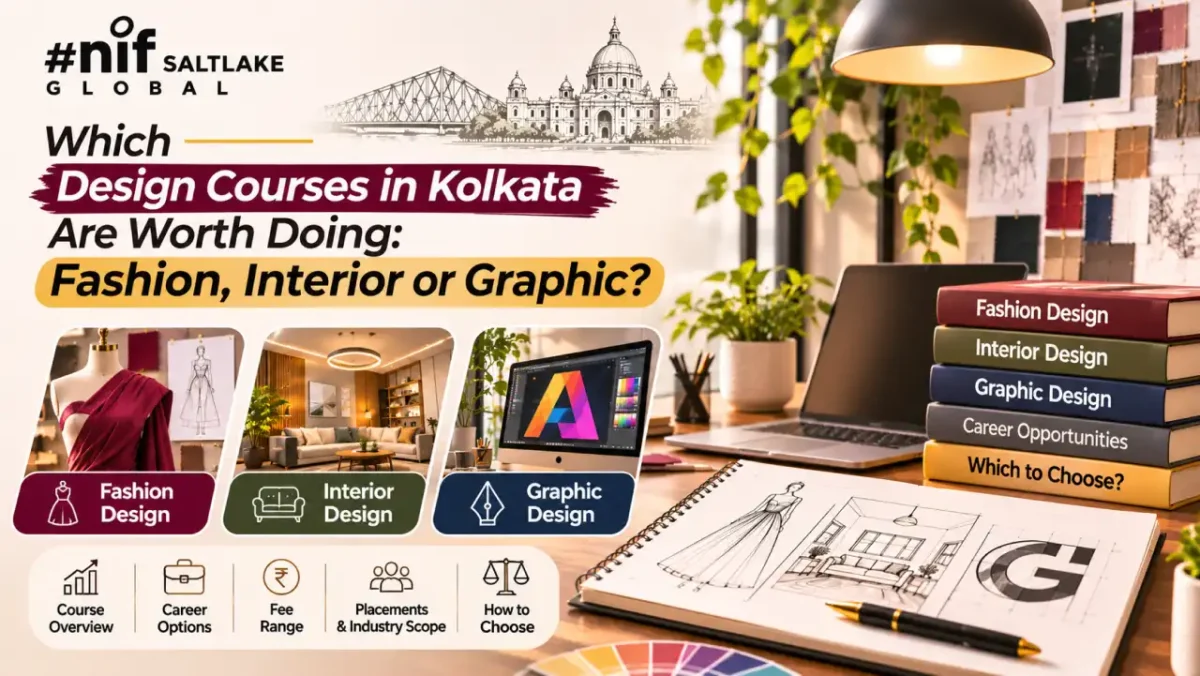
Finishing Class 12 brings one big question for creative students in West Bengal: which design courses in Kolkata are worth doing, fashion, interior or graphic? All three look exciting on Instagram, and all three can lead to a real career. They are not the same job, though. They use different skills, lead to different workplaces and grow at different speeds. This guide compares them so you can pick the one that fits you.
From Bengal’s weavers to the pandal artists of Durga Puja, Kolkata runs on creativity. That is one reason design courses in Kolkata are a popular choice after Class 12 for science, commerce and arts students alike. The honest answer to “which one is worth it” is simple: the course that matches how you like to think and work. Here is what each path involves day to day.
Fashion design covers research, concept building, sketching, fabric and pattern selection, garment construction and trend analysis. It is hands-on, fast-moving and rewards people who notice what others wear and why.
At NIF Global Saltlake Kolkata, the fashion design course in Kolkata is offered as a 4-year B.Des, a 3-year B.Voc, a 2-year M.Voc and a 2-year advance programme.
Interior design is about how people live and work inside a space. You study space planning, materials, lighting, colour, furniture and how to present a concept to a client. A beautiful room still has to work for the people using it, so it mixes creativity with practical thinking.
The interior design course in Kolkata at NIF Global Kolkata follows the same structure: B.Des (4 years), B.Voc (3 years), M.Voc (2 years) and a 2-year advance programme.
Graphic design is visual communication. Logos, packaging, social media creatives, posters, websites and app screens all come from graphic designers. Most of the work happens on a computer, and the field overlaps heavily with digital marketing, branding and UI design.
It is usually taught within communication or visual design programmes, and not every institute offers it, so check course lists carefully.
Here is a quick career comparison to help you see the differences at a glance.
| Factor | Fashion Design | Interior Design | Graphic Design |
| Core focus | Clothing, textiles, accessories | Homes, offices, retail and event spaces | Brands, print and digital media |
| Main skills needed | Sketching, fabric sense, garment construction, trend reading | Space planning, materials, client handling, technical drawing | Typography, layout, colour, visual storytelling |
| Software you will meet | Design and illustration tools, digital pattern tools | 2D drafting and 3D visualisation tools | Image editing, vector and layout tools |
| Typical workplaces | Labels, export houses, retail brands, styling teams | Design studios, architecture firms, real estate, retail | Agencies, in-house brand teams, media, freelance |
| Work style | Studio and hands-on | Studio plus site visits | Mostly screen-based |
| Best for | Trend lovers who enjoy making things | Practical problem solvers who love spaces | Visual thinkers who enjoy digital work |
No, you do not need to be a trained artist to begin. What helps most is:
Drawing matters most in fashion illustration and least in many graphic design roles, where layout and typography carry the work. Interior design sits in between.
Here is a snapshot of common job roles and career options after each course.
After fashion design: fashion designer, fashion stylist, fashion illustrator, textile designer, visual merchandiser, fashion technologist, fashion faculty and fashion entrepreneur. You can explore these in detail on the fashion design career options page.
After interior design: interior designer, space planner, interior stylist, set designer, exhibition designer, retail designer, colour consultant, Vastu consultant and interior design faculty. The interior design career options page breaks these down further.
After graphic design: graphic designer, brand identity designer, packaging designer, social media designer, illustrator, motion designer, and, with extra training, UI or UX designer.
Exposure to real brands speeds up your first job, so check which brands an institute is associated with before you decide.
The figures below are broad, industry-reported ranges for India and vary by city, employer and portfolio.
| Career Stage | Fashion Design | Interior Design | Graphic Design |
| Fresher (0 to 2 years) | Around ₹2.5 to 4 LPA | Around ₹2.5 to 4 LPA | Around ₹2.5 to 4.5 LPA |
| Mid-level (3 to 5 years) | Around ₹5 to 8 LPA | Around ₹5 to 8 LPA | Around ₹5 to 8 LPA |
| Senior or independent | Can go well beyond ₹10 LPA with a strong label or brand role | Can cross ₹12 LPA with a steady client base | Can reach ₹10 LPA and above in brand or UI leadership |
A few insights that matter more than the table:
Once you pick a field, the next decision is the programme type. Among courses after 12th in design, B.Des and B.Voc are the most common.
At NIF Global Saltlake Kolkata, both fashion and interior programmes are listed as UGC and NSDC approved. Eligibility starts at having appeared for or passed Class 12, and you can read the full details on the admission FAQ page.
Looking for the best design college in Kolkata? Instead of chasing rankings, compare design colleges in Kolkata on things that actually shape your career:
The right campus for designing courses in Kolkata leaves you with a strong portfolio, because that is what employers judge.
Still unsure between fashion and interior design? Our counsellors can walk you through programmes, eligibility and career paths in one conversation.
The best design course after 12th is the one that matches your interests. Choose fashion design if you love clothing and trends, interior design if you enjoy spaces and practical problem solving, and graphic design if you prefer digital, visual communication. All three offer solid careers in India.
Fashion design focuses on clothing, textiles and accessories, while interior design focuses on planning and styling homes, offices and commercial spaces. Fashion is more studio- and trend-driven. Interior design involves more client meetings, site visits and technical planning.
Starting salaries for fashion, interior and graphic design are broadly similar in India, often in the ₹2.5 to 4.5 LPA range for freshers. Long-term pay depends on specialisation, portfolio and clients. Experienced interior designers with their own projects often see some of the highest earnings.
No. NIF Global Saltlake Kolkata currently offers fashion design and interior design programmes, including B.Des, B.Voc, M.Voc and advance programmes. Students interested in graphic design should look for a communication or visual design programme.
No, you do not need advanced drawing skills to start a design course. Basic sketching is taught from the beginning. Observation, creativity, willingness to learn software and good communication matter just as much.
Popular options include fashion designer, stylist, illustrator, textile designer, visual merchandiser, fashion technologist and running your own label.
Popular options include interior designer, space planner, set or exhibition designer, retail designer, colour consultant and Vastu consultant.
Ask yourself what excites you more: what people wear or where people live and work. Try a small project in each, such as styling an outfit or redesigning a room on paper. The one you enjoy finishing is usually your answer.